Friday, December 25, 2015

December Newsletter

December Newsletter
Written By Nathan Byrd-NASM CPT
 Season’s Greetings to each and everyone reading this letter. I find pleasure in being able to share with you information that is important not only your mind but your body as well. As we enter into the Holiday Season there are choices when it comes to attending company parties, social gatherings and family parties. I’m not going to be the one saying you cannot eat and try different foods that are prepared for you. I’m going to share with you and few keys points to help you through the holidays and keep you on track with your well being. These newsletter have 4 different topics in them which are pertinent to exercise, mindset, nutrition, and a healthy recipe.    

Mindset

1. GOALS
You must have some form of a goal you are trying to reach. Having a goal to keep you accountable is extremely important.

2. WHY
Know “Why” you have established a goal and know deeply WHY you are trying to reach it.

3. SOCIAL ENVIRONMENTS
Connecting to social groups and the right people who will uplift you in times that you feel you cannot continue on is another very important topic that will help with the overall changes you are seeking to make.

4. EXPECT SETBACKS  
As you continue on your journey you must have expectation knowing there will be setbacks and times of trials. These trials are what can either propel to move forward in life or can cause significant setbacks.  

 Having these four key points be at the foundation of any change whether it be physical, or mental these are universal when it comes to making forms of change.


Fitness
So as we go into the Holiday season we find ourselves being busy with the shopping, the cooking, the parties, the kids, and much more… Good thing is there is something called HIIT training. I will be putting together a sequence of exercises you can put yourself through to maximize the time you have. This routine will take you only 20 minutes and have your metabolism spiked and ready to burn calories.

All exercises are performed for 50 Seconds followed by a 10 Sec. Rest. Repeat for 2 times and you will good!

  1. Mountain Climber
  2. Burpee
  3. Jumping Jack
4. Push ups

5. Jumping lunges
6. Plank Jack
7. Jumps squats

8. High Knees
9. Plank Walks
10. Butt Kicks

If you have any questions on form or how exactly to perform any of these exercises feel free to contact me at n.byrd20@gmail.com.


  Nutrition Supplementation


Omegaguard (Fish Oils)
Omegaguard is produced by using state-of-the-art, proprietary, low temperature, triple molecular distillation and purification process of fish oils that concentrates natural, beneficial omega-3 fatty acids and helps remove harmful contaminants including heavy metals lead, mercury, arsenic, cadmium, dioxins, and PCBs it provides a full spectrum of seven natural omega-3 fatty acids EPA, DHA, AlA and more for cardiovascular health and to support healthy vision, brain and joint functions.

First we are needing to break down exactly what is in Fish oil and how it is important to you.

EPA-  Helping with the reduction of stress by keeping your serum levels at a healthy level. EPA is naturally paired with DHA a related fish oil. Human higher intelligence is directly related to the availability of fish oils.

DHA- Is commonly used for the increase of mental health, focus and clarity. DHA is believed to be necessary for higher learning and may help to increase intelligence in those areas that many are deficient in.

Some common attributes:
  • Improves muscle tone
  • Reduces pain and discomfort
  • Reduces work demand of heart
  • Improves health and vitality of white blood cells
  • Reduces inflammation and joint pain

Click for More Information:


Healthy Recipe


Green Bean Casserole

PREP TIME 10 MIN   TOTAL TIME 40 MIN   SERVES 12

Ingredients

  • 2 cans (10 1/2 ounces each) Campbell’s® Condensed Cream of Mushroom Soup or (10 1/2 ounces) Campbell’s® Condensed 98% Fat Free Cream of Mushroom Soup or(10 1/2 ounces) Campbell’s® Healthy Request® Condensed Cream of Mushroom Soup
  • 1 cup milk
  • 2 teaspoons soy sauce
  • 1/4 teaspoon ground black pepper
  • 8 cups cooked cut green beans
  • 2 2/3 cups French's® French Fried Onions

Directions

  1. Stir the soup, milk, soy sauce, black pepper, beans and 1 1/3 cups onions in a 3-quart casserole.
  2. Bake at 350°F. for 25 minutes or until the bean mixture is hot and bubbling. Stir the bean mixture. Sprinkle with the remaining onions.
  3. Bake for 5 minutes or until the onions are golden brown.

May you have the best year of your life! Remember making small changes that are repeated consistently provide you with the overall results you desire to have. Making the choice to have an awesome year starts with YOU. Its starts with establishing your “WHY” and continuing to attach yourself to what drives you.  2016 is yours and I believe you are capable to achieve anything you put your mind to! Lets GOOOOO!!!!! MERRY CHRISTMAS and HAPPY NEW YEAR!


Wednesday, December 23, 2015

9 Key Points to Making Mental and Physical Change


YOUR BEST YEAR


Hello!!! Here I am again, writing about topics we all are faced with while on our weight loss journeys. They can be long and hard but making sure we follow specific steps that have been laid out from people that have successfully completed transformations is imperative to our success.

2016 has statically shown the Top 3 resolutions are #3. Spend less, Save more. #2.Get more organized and at the top of the list #1 LOSE WEIGHT. The very act of making New Years resolutions improves your odds of success. I have taken the time to do some research to ensure you know 9 key points that will help you in your weight loss journey.
Now that you know some of the reasons so many people fall off the resolution wagon, here are 9 expert tips to help you stick with your own New Year's vows:

1. Have a Realistic Eating Plan
Eating plans that have plenty of variety, yet are simple, interesting, and tastes good -- such as the Mediterranean-style diet with its "good carbs" from fruits, vegetables, and whole grains; healthy fats from nuts, fish, and olive and canola oils; and lean protein.

2. Believe in Yourself
Seeing is believing; once you see you are capable of making changes in your behavior, it inspires confidence. Breaking down a lofty goal into smaller steps is often what is needed to gain the belief that you can do it. The feeling of achievement will be continued motivation and ensure your success.


3. Get Support
Studies show that social support is critical, especially after the first few weeks when your motivation flags. Seek out someone who will be there for you long-term. Some people find success with online support groups while others do better with an exercise buddy. You need to figure out what kind of support will help you during the tough times that are inevitable when changing behaviors.
4. Spell Out the Details
So you want to lose weight or exercise more -- just how do you plan to do it? How will you handle eating out, or a schedule that squeezes out exercise? Devise a sensible plan for how you'll shop, cook, and fit in fitness. Think through how you'll deal with cravings, but don't deprive yourself. If you give yourself permission to eat what really matters to you, it puts you in control (instead of the diet), and empowers you to make a healthy decision on portion size. Don’t deprive yourself of what you really like just be very controlling of your portion sizes.


5. Set Mini-Goals
Maybe you want to lose 50 pounds, but you'll be more motivated to succeed if you celebrate every 10 pounds lost. Realistic resolutions are ones you can live with. Look at them as lots of "baby steps" strung together. Setting the bar too high can be demoralizing. People who set attainable, realistic goals are more likely to succeed.


6. Manage Your Cravings
Cravings for foods are caused by swings in your blood sugar. If you eat the right kinds of foods and snack strategically, you can eliminate cravings, everyone goes through cravings making sure that you are eating every 3-4 hours is extremely important  and always including lean protein (from nuts, low-fat dairy, lean meats, or beans) will satisfy your hunger for fewer calories and without the dramatic swings in blood sugar.
.


7. Control Your Environment
Surround yourself with people, places, and things that will help you change your behavior. Avoid those that invite problems, like going to happy hour or eating at a buffet restaurant.


8. Reward Yourself
Reward yourself all along the way for continued motivation and success. A reward could be a massage, flowers, or removing chores you dislike. Figure out what will work for you and treat  yourself whenever you achieve goals


9. Anticipate Slips, and Deal with them Constructively
 
Don't let a slip-up derail your resolve to improve your health. Setbacks are inevitable; it's how you respond to them that matters. Just think of MLK when he was constantly ridiculed for the changes he believed in, and what happened as a result of his belief, massive change. Making sure you can take a failure and constructively create a positive attitude will help you go far in your goals of weight loss.

Everything that I have covered, steps 1-9 are all things we go through whether your skinny, over weight, or in-shape. The major difference is the mindset of those you aspire to be like is different, they face adversity with a headstrong mindset, never backing down because they know, without a shadow of a doubt they will conquer what is holding them back.They will do whatever it takes, just like a mother with a lost child her pursuit is relentless and will stop at nothing until her baby is safe.

I wanna personally thank you for taking a look at this blog today this valuable information can help change the course of your life and help aid in many successes in the future it gives me great pleasure to share this information with the world!

In starting your journey there are a lot of questions on what to do and exactly how to achieve what you have set out to accomplish. With my years of experience as a personal trainer and helping people with their nutrition

Nathan L. Byrd

NASM- CPT

Key Stretching to Alleviate Back Pain


Key Stretches to Decrease Back Pain


Stretch Routines

Spine stretch

Sitting on the floor with your feet wider than your hips, nod your head forward and begin to bend forward by hinging at the hips. Breathe normally. As you go down, draw your chin into your neck.

Cat-camel back stretch


Assume the prone position with all fours on the floor. Imagine a string attached to the middle of your spine and someone is pulling it straight in the air. Remember to tighten core as your back begins to curve.
Do this slowly and gently, and don’t force it. One cycle will take three to four seconds. Repeat 5-6 times. .

Supine cross-leg spinal twist

Pull legs up to a 90 degree angle keep one arm rested strait on the ground and the other

Low-back rotation stretch

Sitting on a chair with your feet flat on the floor, twist your upper body so your shoulders rotate to one side. You can use the chair for support, holding on to get a deep muscle stretch.


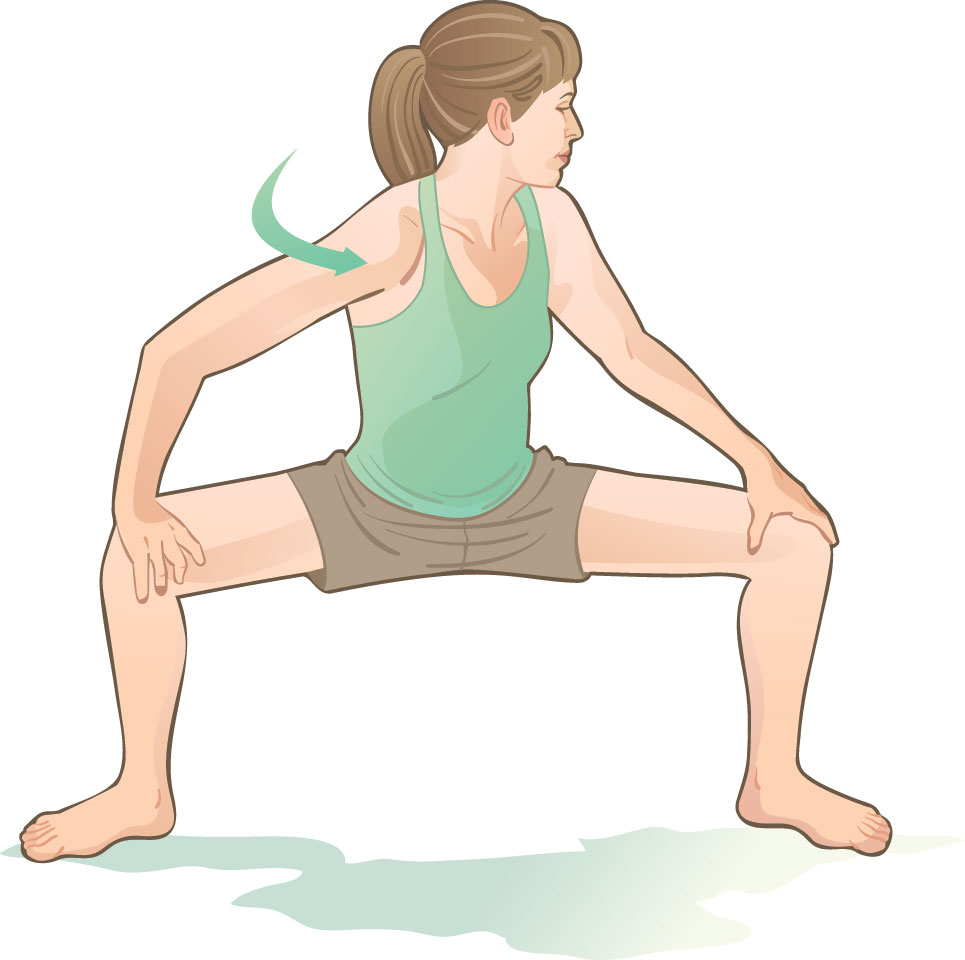
Squat stretch

With a wide stance place both hands on thighs and dip shoulder slightly inward and twist torso. Hold for 30 sec, then rotate to the other side.


Mermaid stretch
Sit on the floor with your knees bent underneath you to your left. With your left hand, hold on to your ankles. Raise your right arm and inhale. Extend and reach that arm over your head, and exhale as you feel the stretch along the right side of your torso. Hold for 20 to 30 seconds. Repeat twice; switch sides and do three reps.

Seated forward bend

Sit on the floor with your legs straight out in front of you. Hook a yoga strap or towel around the bottoms of your feet, and leave it there for now. Inhale and reach your arms up to the ceiling. Exhale and begin to bend forward gently by hinging at the hips, and bring your belly down to your thighs. Grasp the yoga strap or towel, keeping your back straight. Hold for 30secs and 3 reps

Spinal trunk rotation

Lie on your back and bring knees up toward your chest so your body is positioned as if you’re sitting in a chair. Your knees and hips should be bent at 90-degree angles. Now, place the palms of your hands flat on the floor. Go from the left to the right and hold for 15 seconds on each side until you switch to the other side. 10 reps and 2 sets


Wall slide

Stand against a wall so your tailbone, shoulder blades and head are all pressed against the wall. Hold your hands at shoulder level with your elbows bent at 45 degrees, and palms facing forward. Slowly extend your arms up the wall, pointing your hands as far up as they’ll go, not moving your tailbone, shoulder blades or head, and keeping them pressed against the wall. Repeat this for 12 reps for 3 sets.

Seated spinal twist

Begin by sitting tall, extending both legs in front of you. Bend right knee and cross it over the left thigh, then bend left knee (you can keep your left leg straight if necessary). Take left elbow and place it on the outside of the right knee, then place right hand on the floor behind you, looking over your right shoulder.
Hold and breathe deeply for 15 to 30 seconds, and release.


Created By:
Nathan Byrd NASM- CPT

Thursday, December 3, 2015

7 Common Question about Sodium


Information on Sodium


Image result for salt1. What’s bad about sodium?
Too much sodium in your system causes your body to retain (hold onto) water. This puts an extra burden on your heart and blood vessels. In some people, this may
lead to or raise high blood pressure. Having less sodium in your diet may help you lower or avoid high blood pressure. People with high blood pressure are more likely
to develop heart disease or have a stroke.

2.  How much sodium do I need?
Most people eat too much sodium, often without knowing it. One teaspoon of salt contains about 2,300 mg of sodium.
• The average American eats about 3,400 mg of sodium a day.
• All Americans should reduce the amount of sodium in their diet to less than 1,500 mg a day.
• Your doctor may tell you to cut salt out completely.
3. What are sources of sodium?
Most of the sodium in our diets comes from adding it when food is being prepared. Pay attention to food labels, because they tell how much sodium is in food products.
For example: foods with 140 mg or less sodium per serving are considered low in sodium.
Here’s a list of sodium-containing compounds to limit in
your diet:
• Salt (sodium chloride or NaCl)
• Monosodium glutamate (MSG)
• Baking soda and baking powder
• Disodium phosphate
• Any compound that has “sodium” or “Na” in its name.
Some over-the-counter and prescription medicines also contain lots of sodium. Talk to your health care provider and make it a habit of reading the labels of all over-the-counter drugs, too.
4. What foods should I limit?
The best way to reduce sodium is to avoid prepackaged, processed and prepared foods, which tend to be high in sodium.
Watch out for the “Salty 6” — the top six common foods that add the most salt to your diet.
Read food labels and chose the lowest level of sodium you can find for these items
Image result for pizza:• Breads and rolls
• Cold cuts and cured meats
• Pizza
• Poultry
• Soup
• Sandwiches
5. Why should I limit Sodium?
You may have been told by your healthcare provider to reduce the salt in your diet. Table salt is sodium chloride. You need a certain balance of sodium and water in your body at all times to work properly. Too much salt or too much water in your system will upset the balance. When you’re healthy, your kidneys get rid of extra sodium to keep the correct balance.

These are some other foods that can also be sources of
“hidden” sodium:
• Cheeses and buttermilk
• Salted snacks, nuts and seeds
• Frozen dinners and snack foods
• Condiments (ketchup, mustard, mayonnaise)
• Pickles and olives
• Seasoned salts, such as onion, garlic and celery salts
• Sauces, such as barbeque, soy, steak, and Worcestershire

6. How can I cook with less salt and more
flavor?
• Avoid adding table salt to foods.
• Use herbs and spices to add flavor to foods.
• Eat fresh fruits, vegetables, lean meats, skinless
poultry, fish, and tuna canned in water.
• Choose unsalted nuts and low-sodium canned foods.
Cook dried peas and beans.
• Use products made without added salt; try low-sodium
bouillon and soups and unsalted broth.
• Rinse canned vegetables, beans and shellfish to reduce
salt.
• Sprinkle vinegar or citrus juice on foods.


7. What about eating out?
Image result for fresh vegetables
Controlling your sodium intake doesn’t mean spoiling the pleasure of eating out. But order carefully. Consider these tips for meals away from home:
• Select fresh greens and fruits when available. Ask for
oil and vinegar to top your salad or dressing on the
side.
• Be specific about what you want and how you
want your food prepared. Request that your dish be
prepared without added salt.
• Remember portion control. You can always bring home
a to-go box!